

Standard Window Sizes & Shade Sizing Chart
Standard window shade sizes usually follow common residential window widths such as 24, 30, 32, 34, 36, 48, 60, and 72 inches, with shade heights often landing around 36, 48, 60, 64, 72, and 84 inches. Use those numbers as a shopping shortcut, then measure your exact window before ordering because inside mount, outside mount, trim, depth, and factory deductions change the final shade size.
Standard Shade Size Chart
Most standard window shade sizes match common residential window widths: 24, 30, 32, 34, 36, 48, 60, and 72 inches. Heights often cluster around 36, 48, 60, 64, 72, and 84 inches. Treat those as shopping filters, then order from exact measurements because inside-mount shades need clearances and factory deductions.

A standard size is a starting point, not a promise. A 36-inch-wide bedroom window may measure 35 7/8 inches inside the frame, 36 1/4 inches across the trim, or 38 inches if you want extra side coverage for blackout. Same window. Different shade order.
Here’s the quick planning chart:
| Window type | Common window size examples | Common shade size range | Best sizing move |
|---|---|---|---|
| Single-hung / double-hung | 24x36, 28x54, 32x54, 36x60 | 24-48 in. wide, 36-84 in. tall | Measure each opening; older homes vary by room |
| Casement | 17x36, 24x48, 30x60, 35x60 | 18-36 in. wide, 36-72 in. tall | Check crank handles before choosing inside mount |
| Sliding window | 36x24, 48x36, 60x48, 72x48 | 36-72 in. wide, 24-60 in. tall | Wider shades need enough headrail support |
| Picture window | 48x48, 60x48, 72x60, 96x60 | 48-96 in. wide, 48-84 in. tall | Custom sizing usually fits cleaner |
| Bathroom / small window | 18x24, 20x30, 24x36, 30x36 | 18-36 in. wide, 24-48 in. tall | Prioritize privacy and moisture-smart fabrics |
| Patio or door glass | 60x80, 72x80, 96x80 | 60-96 in. wide, 80-84 in. tall | Confirm product limits before ordering |
Width causes more trouble than height. A roller shade that’s a little longer can usually roll up with extra fabric on the tube, while a shade that’s 1/2 inch too narrow leaves bright side gaps. Roman shades and cellular shades are less forgiving on height because extra length can bunch, drag, or look heavy at the sill.
One more detail people miss: “window size” and “shade size” aren’t always the same thing. Window manufacturers talk about frame sizes, rough openings, visible glass, and replacement sizes. Shade shoppers need the finished space where the shade will sit.
> Quick rule: inside mount starts with the inside opening. Outside mount starts with the coverage area you want on the wall or trim.
Window Type Size Ranges
Double-hung windows are the easiest to size because they’re usually taller than they are wide. If your home was built with 32x54 or 36x60 bedroom windows, you’ll find plenty of shade options that feel familiar. Still, don’t copy one bedroom measurement across the whole hallway. Drywall, trim build-up, and old paint can steal 1/8 inch on one side. That tiny number matters when a shade has to fit inside a frame.
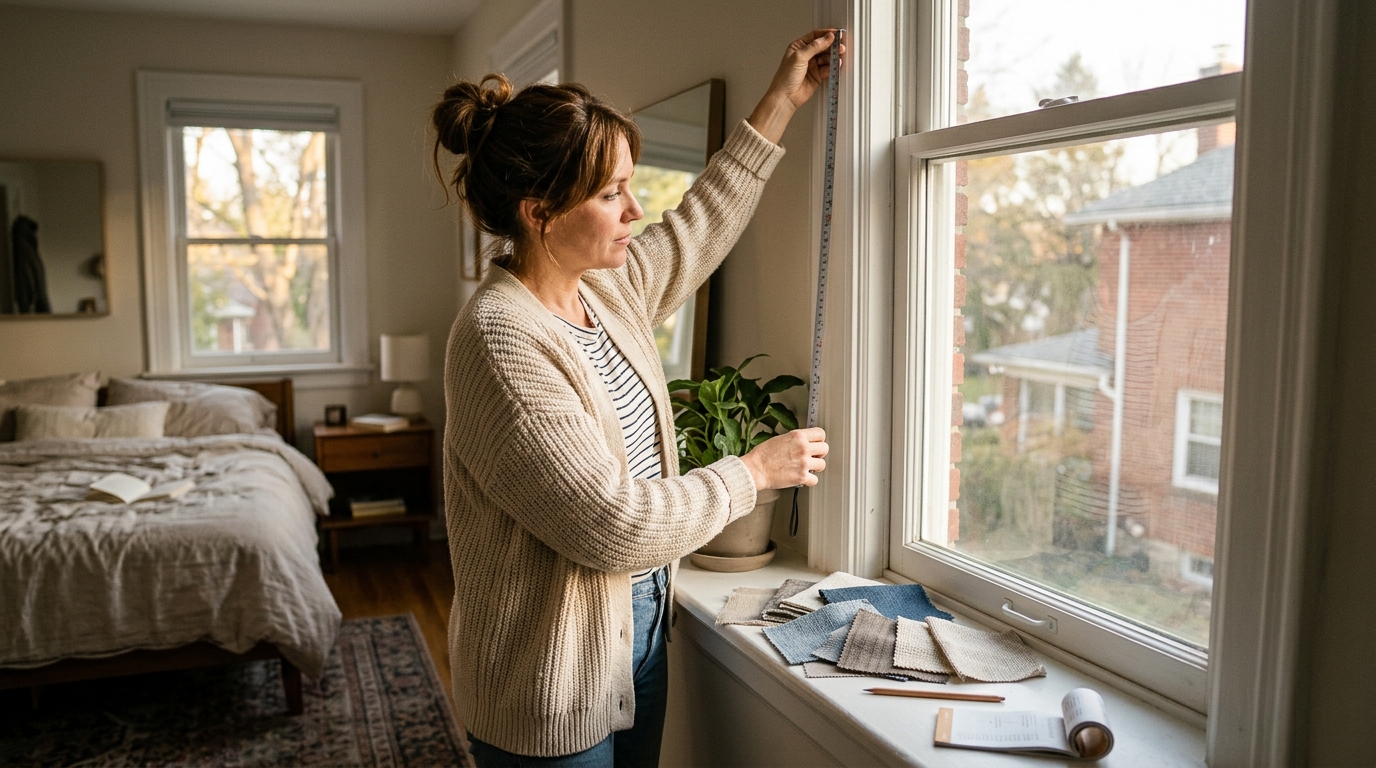
Casement windows need a little more care. The glass may look simple, but crank hardware can sit right where the shade wants to hang. If the crank handle sticks into the opening, outside mount works better. You’ll lose the tucked-in look of inside mount, but you’ll avoid scraping fabric every time you open the window.
Sliding and picture windows are where custom sizing starts to feel less like a luxury and more like the normal answer. A 72-inch-wide window can look clean with one wide shade, but two smaller shades may be easier to lift, adjust, and align. For picture windows in living rooms, wider fabric panels can also show slight waves depending on material and product type. That isn’t a defect; it’s physics.
| If your window is... | Start with... | Watch for... |
|---|---|---|
| Tall and narrow | Inside mount if depth allows | Uneven side jambs |
| Wide and short | One wide shade or split shades | Headrail limits and fabric weight |
| Deep-set | Inside mount | Minimum mounting depth |
| Shallow-set | Outside mount | Trim coverage and wall clearance |
| Near a crank | Outside mount | Handle movement |
| In a rental | No-drill option where available | Lease rules and frame surface |
Bedroom egress deserves a separate warning. The 2021 International Residential Code Section R310 sets emergency escape openings at 5.7 square feet of net clear opening in many above-grade cases, with minimum net clear width of 20 inches and height of 24 inches. A shade doesn’t change that code math, but it should never make the window harder to open in an emergency.
This advice doesn’t apply cleanly to arched windows, skylights, glass block, garden windows, or bay windows with angled side panels. Those need product-specific measuring rules. If you’re measuring a 1920s Craftsman with wavy trim or a condo with metal frames, pause before ordering by chart alone.
Inside Mount Size Rules
Inside mount looks tailored because the shade sits inside the window frame. It’s the best choice when you want a built-in look, when trim is worth showing, or when furniture sits close to the window. The tradeoff is simple: your measurement has to be more exact because the shade must fit between two side surfaces.

If you’re still choosing between recess fit and face fit, AOSKY’s guide to inside mount vs outside mount is the better next read. For sizing, the big idea is this: inside mount depends on the narrowest usable width, while outside mount depends on the coverage you want.
Use this measuring flow for inside mount:
Measure the inside width at the top, middle, and bottom.
Write down the narrowest width, down to the nearest 1/8 inch.
Measure the inside height on the left, center, and right.
Check the shallowest depth, including locks, cranks, tile, and old trim.
Compare your numbers with the product page’s minimum depth and ordering rules.
Do not round up. If the inside opening is 34 7/8 inches wide and you order 35 inches because it “sounds standard,” the shade may not fit. That’s the kind of tiny mistake that makes online custom ordering feel stressful.
AOSKY built FREE Measurement Assurance for this exact moment. Under the Buy Risk-Free policy, AOSKY covers a one-time free remake per order for qualifying sizing mistakes reported within 30 days of delivery. It covers minor measuring mistakes within reasonable tolerance, typically around plus or minus 1 inch, with exclusions for issues like uneven walls, non-square windows, installation damage, and major measuring errors.
Outside mount gives you breathing room. For most shades, adding 2 to 4 inches to total width helps reduce side light, and adding 3 to 6 inches to total height gives the shade room above the glass. For blackout bedrooms, go wider when trim and wall space allow. Those side gaps are where early-morning sun sneaks in.
Custom vs Ready-Made Sizes
Ready-made shades work best when your window sits close to a common size and you’re flexible on mount style. A renter with a 34-inch-wide apartment window might find a stock shade that fits outside the frame beautifully. A homeowner trying to blackout a nursery with a 34 5/8-inch inside opening will usually be happier with custom.

If standard window shade sizes line up with your measurements, start with AOSKY’s ready-made shades. They’re the practical pick for common windows, faster decisions, and rooms where perfect edge-to-edge coverage isn’t the whole point. Think guest room, laundry room, home office, or a sunny breakfast nook where light filtering is welcome.
Custom shades are better when the fit needs to be exact. That includes inside mount, blackout bedrooms, wide picture windows, paired living room windows, older homes, and windows with trim that isn’t square. AOSKY lets you order through the full custom shades and blinds collection, with custom sizing available online in about 5 minutes and typical lead time of 6-12 business days.
| Choose ready-made when... | Choose custom when... |
|---|---|
| Your window is close to a stock width | Your opening has odd 1/8-inch measurements |
| Outside mount is acceptable | You want a clean inside mount |
| You need a simple light-filtering fix | You need stronger blackout coverage |
| The room is low-risk | The room is a bedroom, nursery, or main living space |
| You’re testing a look | You want the finished result to feel built-in |
Renters should pay special attention to no-drill options. AOSKY offers no-tools installation options on select products with spring-tension mount brackets, so you can avoid screws, adhesive, and permanent holes where the product supports that mount type. That’s useful in apartments, dorm-style rentals, short-term housing, and homes where you simply don’t want to drill into fresh trim.
There is one drawback: no-drill spring-tension mounting needs a stable surface to push against. If your window frame is crumbly, textured, bowed, or too shallow, choose another mounting method or ask support before ordering. A shade that fits on paper still needs a frame that can hold it.
Room-by-Room Shade Sizing
A living room shade can be slightly forgiving if the goal is softer light. A bedroom shade can’t. You notice the mistake at 6:12 a.m., when a thin stripe of sun lands across your pillow and the room suddenly feels less finished. That’s why the same 36x60 window might need different sizing decisions in different rooms.

For bedrooms, outside mount often beats inside mount when blackout matters most. The shade can overlap the glass and trim, which cuts side glow. Inside mount looks cleaner, but even a perfect inside mount can leave a slim light line because the fabric has to clear the frame and hardware.
| Room | Common window pattern | Better sizing choice | Why it works |
|---|---|---|---|
| Bedroom | 30x54, 32x54, 36x60 | Outside mount for blackout | Extra overlap reduces side light |
| Living room | 48x48, 60x48, 72x60 | Inside mount or split custom | Cleaner view and easier lifting |
| Bathroom | 18x24, 24x36, 30x36 | Inside mount when possible | Privacy without bulky trim coverage |
| Kitchen | 24x36, 30x36, 36x48 | Shorter, easy-clean shade | Less fabric near sink and counters |
| Home office | 36x48, 48x48, 60x48 | Light filtering or solar control | Cuts glare without closing the room |
Energy choices come after sizing, not before it. The U.S. Department of Energy Energy Saver says insulated cellular shades can be a good choice for households seeking energy savings, comfort, privacy, and resale value. In real life, that means gaps matter. A good fabric with a sloppy fit won’t perform as well as the same fabric measured tight to the right opening.
If comfort is the goal, look at cellular shades for bedrooms, nurseries, and west-facing rooms that run hot in late afternoon. If the room needs a sleeker look with simple daily use, roller or zebra styles may fit the mood better. The right product depends on light control, privacy, cleaning, lift type, and how often you open the window.
Bathrooms and kitchens deserve their own warning. Don’t size fabric so wide that it crowds tile, faucets, cabinet pulls, or a backsplash. A half inch of extra coverage may look harmless on the order page; beside a sink, it can turn into damp fabric and daily annoyance.
Measuring Mistakes To Avoid
The most common sizing mistake is measuring the glass instead of the space where the shade mounts. Glass size tells you almost nothing about shade fit. The shade attaches to the frame, trim, wall, or mounting bracket area, so that’s the surface that matters.
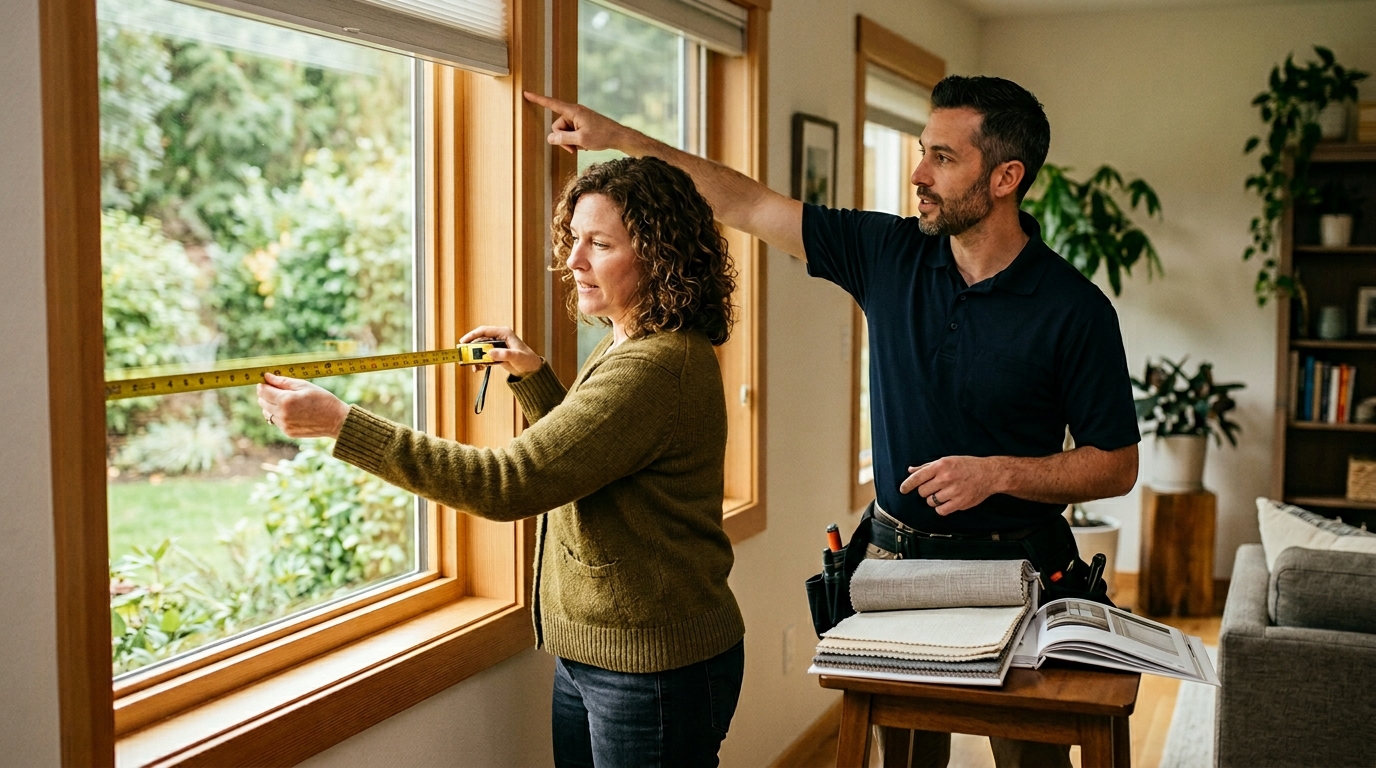
The second mistake is trusting the label on an old window. A replacement window may be sold as 36x60, but the actual visible frame opening can be smaller. New trim can make it smaller again. Paint can make it smaller again. Then you order a “standard” shade and wonder why it sticks halfway up the jamb.
Avoid these sizing traps:
| Mistake | What happens | Better move |
|---|---|---|
| Measuring only once | You miss a bowed frame | Measure width and height in several spots |
| Rounding up | Inside mount may not fit | Record to the nearest 1/8 inch |
| Ignoring depth | Brackets may hit glass or hardware | Check minimum depth on the product page |
| Copying one window | Matching rooms still vary | Measure every window separately |
| Forgetting handles | Fabric rubs or blocks operation | Test crank and lock clearance |
| Ordering too narrow | Light gaps show | Add outside-mount overlap where possible |
Take photos while you measure. One straight-on photo, one close-up of the tape, and one side photo showing depth can save time if you contact support. AOSKY’s live chat expert support is there 24/7, and free fabric samples help you check color and texture before you commit to a full room.
AOSKY’s 3-Year Limited Warranty covers defects, internal mechanisms, and brackets, but warranty coverage isn’t a substitute for measuring well. That distinction matters. A defective bracket is a product issue. A window that was measured from the wrong edge is a sizing issue, which is why Measurement Assurance is so useful when the mistake falls within the policy.
Before you order, run this 60-second check:
Did you choose inside mount or outside mount?
Did you measure width, height, depth, and obstruction clearance?
Did you write numbers in inches to the nearest 1/8 inch?
Did you compare your numbers with the product page?
Did you save photos in case support needs them?
A chart gets you close. A tape measure gets you the shade that actually fits.
FAQ
What shade sizes are standard?
Common shade widths include 24, 30, 32, 34, 36, 48, 60, and 72 inches. Common heights include 36, 48, 60, 64, 72, and 84 inches, but exact ordering should come from your measured window.
Do shades match window size?
Sometimes, but not always. Inside mount shades usually use the inside opening measurement, while outside mount shades are often wider and taller than the window for better coverage.
How do I measure shades?
Measure width at the top, middle, and bottom, then use the narrowest width for inside mount. Measure height in several spots too, and check depth before ordering.
Are custom shades worth it?
Custom shades are worth it for inside mounts, blackout rooms, wide windows, older homes, and odd-size openings. Ready-made shades work well when your window is close to a stocked size.
Can renters use custom shades?
Yes, renters can use custom shades, especially when no-drill installation is available for the product. Check your lease, confirm your frame depth, and choose spring-tension mount options where supported.
For the best fit, measure first, choose your mount style second, then compare ready-made and custom options. AOSKY makes that easier with no-drill options on select shades, FREE Measurement Assurance, free samples, fast free shipping, 24/7 live chat support, and a 100% Satisfaction Guarantee, so your next step is simple: measure one window today and decide whether ready-made or custom gives you the cleaner fit.
Share