

Zebra vs Roller vs Cellular Window Shades Compared in 2026
Quick answer: if you want light control with a modern look, pick zebra shades; if you want the simplest clean line at the best price, pick roller; if your priority is insulation against a drafty window, pick cellular. That's the short version of any honest types of window shades comparison, and the rest of this page exists so you can pick the right one for your window instead of the one a showroom wants to upsell.
We make all six of these at AOSKY, so this isn't a roundup written by someone guessing. It's what we tell customers on live chat when they're stuck between two tabs at 11pm. Below you'll find a full comparison table across zebra, roller, cellular, roman, Shangri-La, and woven wood, then the real tradeoffs nobody puts on a product page.
Window Shades Comparison Table
Here's every type side by side. Use it to narrow to two, then read those two sections in detail.

| Shade type | Light control | Insulation | Best room | Renter-friendly | Style read |
|---|---|---|---|---|---|
| Zebra (dual roller) | Excellent — sheer-to-solid in one pull | Moderate | Living room, bedroom, office | Yes (no-drill option) | Modern, layered |
| Roller | Good — one fabric, pick the opacity | Low to moderate | Anywhere, especially kitchens | Yes (no-drill option) | Clean, minimal |
| Cellular (honeycomb) | Good — light filtering or blackout | Best of the six | Bedrooms, drafty rooms, nurseries | Yes (no-drill option) | Soft, understated |
| Roman | Good — depends on fabric and lining | Moderate (with lining) | Dining rooms, formal spaces | Less so (mounting matters) | Warm, tailored, fabric-forward |
| Shangri-La (sheer) | Excellent — floating sheer vanes | Moderate | Living room, sunrooms | Yes | Soft, luxe, diffused glow |
| Woven wood | Good — light filters through; add liner for privacy | Low (liner helps) | Sunrooms, boho/coastal rooms | Yes | Natural, textured, organic |
One note before you trust any single column: "best room" is a starting point, not a rule. People run roller shades in bedrooms all the time with a blackout fabric. The table tells you where each one shines by default. Your house gets a vote.
If you'd rather skip ahead and browse, every type above lives in our collection of custom shades, all made to your exact measurements.
Zebra Shades Explained
Zebra shades are two layers of fabric on one roller — alternating sheer and solid stripes. Roll them so the stripes line up and you get a soft, filtered glow. Shift them a few inches and the solid bands stack, blocking the view. One mechanism, two completely different rooms depending on the time of day.
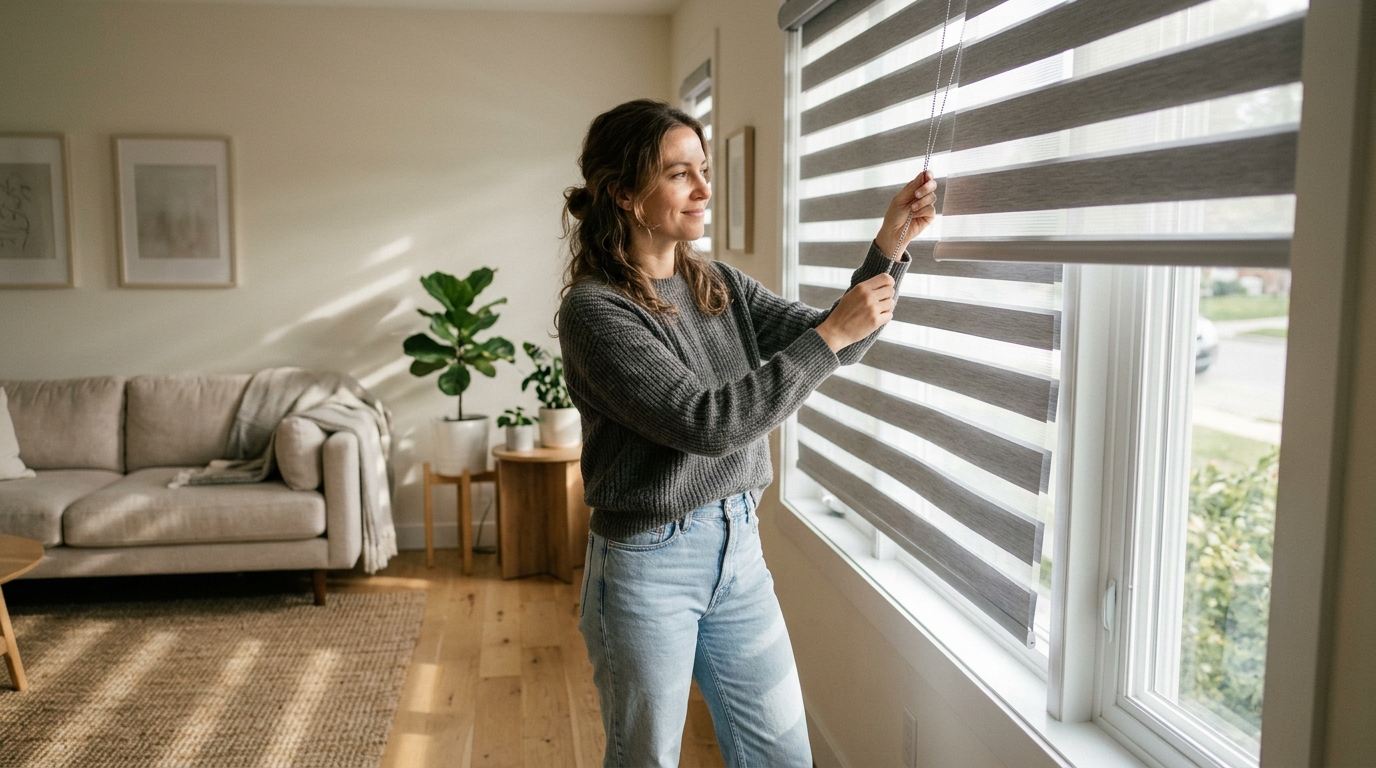
That's the trick people fall for. You're on a video call and the afternoon sun is blowing out the window behind you. Half-roll the zebra shade and the glare drops without killing the daylight. Around dinner, slide it to solid for privacy from the street. No swapping curtains, no fighting with a second sheer panel.
Where do they fall short? Pure blackout. Even at full solid, a little light sneaks through the seams where the bands meet, so a serious light sleeper in a sun-facing bedroom might still notice a faint glow at the edges. For that exact problem cellular wins, and we'll get there. But for a living room, a home office, or a bedroom where you just want it dim, zebra shades are the most flexible single thing you can hang.
They also read as the most current of the six. If your reference point is a Pinterest board from this year, zebra is probably already on it.
Roller Shades Explained
A roller shade is one flat piece of fabric on a tube. You pick the fabric, the fabric decides everything — opacity, texture, how much it costs. That simplicity is the whole pitch.
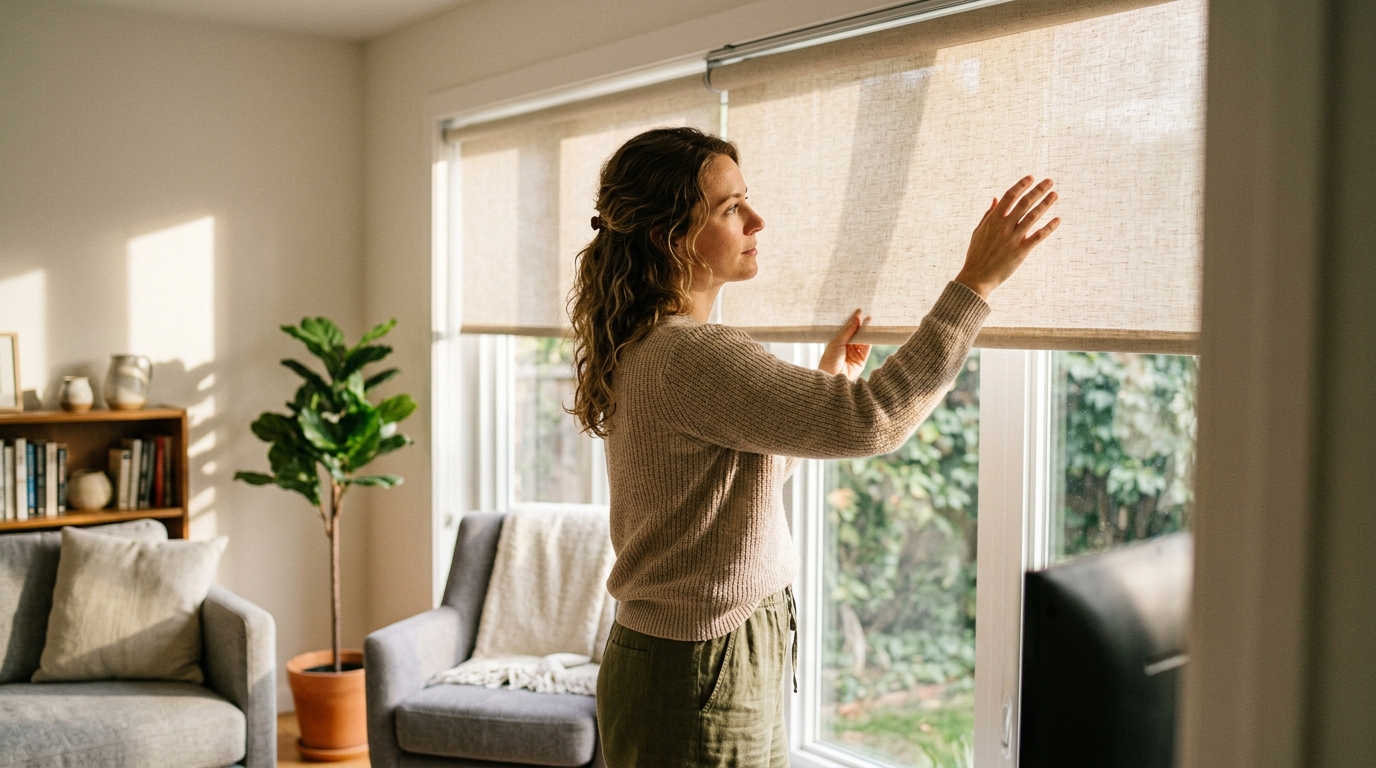
Roller shades have the fewest moving parts of anything here, which means the fewest things that can rattle, snag, or wear out. They sit nearly flush to the glass, so they disappear when raised. And the fabric range is wide: a light-filtering linen-look weave for a kitchen, a 5% solar screen that cuts heat but keeps your backyard view, a true blackout for a nursery. Same hardware, radically different result.
The honest tradeoff is that one fabric means one behavior. Unlike a zebra shade, a roller can't be sheer and private from the same position — you commit to an opacity when you order. Plenty of people solve this by layering: a solar roller for daytime glare plus a separate blackout for sleep. Two shades, two jobs.
For renters and anyone allergic to drilling, this is the easy yes. Our roller shades come with a no-drill, no-tools mount — spring-tension brackets that press into the window frame in seconds, no adhesive, nothing your landlord will notice when you take them down. Order, measure, mount, done.
Cellular Shades Explained
Cellular shades are the insulation pick, full stop. The fabric folds into hollow honeycomb cells that trap a pocket of air against the glass, and that air pocket is what slows heat moving in or out. If you've ever sat next to an old window in January and felt the cold radiating off it, this is the shade that fixes that feeling.

We won't quote you an R-value here, because the number depends on the exact cell size and configuration and we'd rather not invent a spec — the cellular shades product page has the details for each option. What we'll say plainly: among these six, nothing else competes on thermal performance. Double-cell beats single-cell. A snug inside mount beats a sloppy one. Fit matters as much as the fabric.
There's a quieter benefit people don't expect. Those air pockets dampen sound. Not soundproofing — your neighbor's leaf blower still exists — but the room feels a notch calmer. Combine that with a blackout cellular fabric and you've got the standard recipe for a good nursery: dark, quiet, insulated.
The cosmetic tradeoff is that cellular reads soft and plain. It doesn't make a statement. If you want the window itself to be a design moment, look at roman or woven wood instead. If you want the window to behave and otherwise stay out of the way, cellular's your answer.
Roman, Shangri-La & Woven Wood
The first three are the volume sellers. These three are where you go when the window is part of the decor, not just a thing to cover.
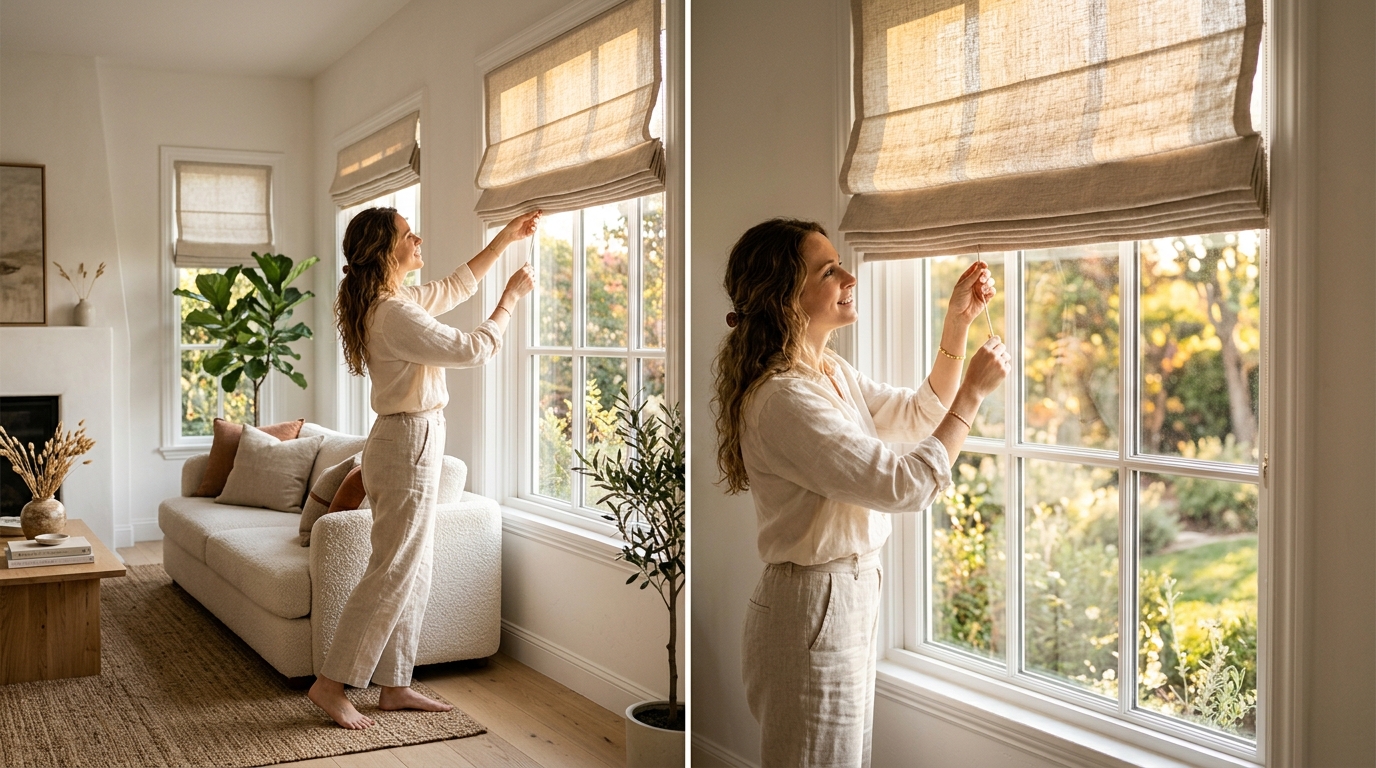
Roman shades fold up into stacked horizontal pleats of real fabric, so they bring the warmth of a curtain with the clean operation of a shade. Add a lining and they handle light and a bit of insulation well; skip the lining and they stay airy and casual. Dining rooms, reading nooks, any room where you want softness — that's roman territory. They're the least renter-friendly of the bunch only because mounting them well takes a little more care, but our custom roman shades are built to your opening so the fit does most of the work for you.
Shangri-La shades (you'll also see them called sheer shades or "silhouette" style) float horizontal fabric vanes between two sheer layers. Tilt the vanes open and light diffuses into a soft glow that hides the harsh edges of direct sun. Tilt them closed for privacy. They're the prettiest way to manage daylight in a living room or sunroom, and they cost more than a basic roller because there's simply more fabric and engineering inside.
Woven wood shades are made from real grasses, reeds, and bamboo. They're the texture play — instantly warm, a little coastal, a little boho. Light filters through the weave in a way that feels alive, which is also the catch: raw woven wood isn't private, so for a bedroom or bath you'll want to add a liner. In a sunroom where privacy isn't the point, they're hard to beat.
A rough way to choose among these three: roman for tailored warmth, Shangri-La for soft luxury and light play, woven wood for natural texture. None of them is the "performance" pick — that's still cellular — and that's fine. They're earning their spot on looks.
How to Choose Your Shade
Don't start with the type. Start with the problem the window has.

Glare on a screen? Solar roller or a half-rolled zebra.
Cold or hot room, high energy bill? Cellular, double-cell if you can.
Need true dark for sleep? Blackout cellular or a blackout roller.
*Want privacy and daylight at once?* Zebra or Shangri-La.
Window is the focal point of the room? Roman or woven wood.
Renting and can't drill? Any of these with our no-drill mount — but roller and cellular are the simplest to put up yourself.
Notice how often two types tie. That's normal. When you're down to two, the tiebreaker is usually budget or look, and at that point ordering free fabric samples settles it faster than any article can — feeling the opacity in your own light, in your own room, beats reading about it.
One more thing experts do that beginners skip: they measure twice and mount inside the frame when the window depth allows. An inside mount gives the cleanest line and, for cellular, the best seal. If your frame's too shallow, outside mount is fine and actually blocks more edge light. Either way, our worry-free measuring guide walks you through it, and every order is backed by FREE Measurement Assurance — if a sizing mistake is on the measurement, you get a one-time free remake within 30 days of delivery. That's the part that makes ordering custom online feel safe instead of scary.
FAQ
What are the most popular types of window shades?
Zebra, roller, and cellular shades are the three most popular for US homes. Roller leads on price and simplicity, zebra on flexible light control, and cellular on insulation.
Are zebra or roller shades better?
Zebra shades win if you want sheer-and-private from one shade; roller wins on price and a cleaner minimal look. Zebra costs a bit more for that extra flexibility.
Which window shades are best for insulation?
Cellular (honeycomb) shades insulate best because their air-pocket cells slow heat transfer at the glass. Double-cell outperforms single-cell, and a snug inside mount improves the seal.
Can renters install custom shades without drilling?
Yes. AOSKY offers no-drill, no-tools mounting with spring-tension brackets that press into the window frame — no adhesive, no holes, and easy to remove when you move out.
What's the best blackout shade for a bedroom?
A blackout cellular shade is the strongest pick for bedrooms because it blocks light and insulates at once. A blackout roller is a good lower-cost alternative for a clean look.
Still torn between two types? That's the right place to be — it means you've narrowed it down. Grab free fabric samples, measure with our worry-free guide, and order custom in about five minutes from the full AOSKY shade collection. With 100+ fabric options, a 100% Satisfaction Guarantee, and 24/7 live chat if you get stuck, there's no wrong window to start with.
Share