
Home
/
Zebra Shades Guide
/
Custom Zebra Blinds: The Complete 2026 Buyer's Guide (What Every Homeowner Gets Wrong)

Custom Zebra Blinds: The Complete 2026 Buyer's Guide (What Every Homeowner Gets Wrong)
Most homeowners find zebra shades through a beautiful photo on social media — the clean horizontal lines, the soft filtered light, the effortlessly modern look. What you don't see in that photo is everything that can go wrong: ordering the wrong material for a humid bathroom, overlooking new child safety regulations, or spending twice what they need to because they didn't compare alternatives first.
Trust me, I've made thousands of zebra shades for our clients and many of them do not know what they want in the beginning. That's why we made this compelete guide for you guys. Our article goes beyond the basics to give you the critical insights, honest trade-offs, and practical buying steps that most articles leave out.
Of course, we might update this guide in the future as we find more points as our customers growing. That's because they would ask some questions before or after buying the shades.
What Are Zebra Blinds, Really?
At their core, zebra blinds are a hybrid window treatment. Roller shades and zebra shades are both types of window treatments that offer light control and privacy. I would say zebra blinds are actually a type of roller shade, and both types operate on the same basic mechanism: a roller tube that raises and lowers the fabric.
Difference? most roller shades feature a single continuous fabric while zebra shades using alternating sheer and solid fabric stripes for a more adjustable light filtering effect. As The Shade Store describes, they're comprised of two layers of material with alternating sheer and opaque bands that you can adjust to let light through or overlay for privacy.
Think of zebra blinds like a Venetian blind and a roller shade had a sleek, fabric-wrapped child. You get the variable light control of blinds with the clean profile of a shade — but in a single, continuously looping piece of fabric. Zebra blinds are actually a type of roller shade, and both types operate on the same basic mechanism: a roller tube that raises and lowers the fabric.
For those who don't know, zebra blinds (also known as double roller shades, dual sheer shades, or banded shades) are one of the fastest-growing window treatment categories in the market. We wrote a very specific article to explain this type of blinds.
Easy Reader News reports that interest in zebra blinds has surged in recent years, with layered and light-filtering blinds now accounting for over a third of new blind installations. But that doesn't mean zebra shades fit for every room.
What Most People Get Wrong About Zebra Blinds
Before diving into the buying process, let's address three assumptions that most people regret later on. And we got this because these are what our customers said.
Mistake #1: Expecting True Blackout Performance
Yes, people hople zebra shades can do blackout. But they don't. This is the most common misconception. Although zebra shades provide excellent light control, achieving full blackout is challenging compared to dedicated blackout roller shades. Even with blackout-rated opaque bands, small gaps can appear between the fabric stripes or at the edges, allowing some light leakage. We put this into our 10 things of zebra shades article. But most won't get it.
If your primary goal is pitch-black darkness for a nursery, home theater, or bedroom where even minor light leakage is unacceptable, zebra blinds alone won't cut it. You'll either need to pair them with blackout curtains or choose a dedicated blackout roller shade instead.
Mistake #2: Ignoring the "Hidden" Cost Gap
The Shade Store describes zebra blinds as "an affordable window treatment solution." That's relative. Although at AOSKY, we sell zebra shades, compared to other blinds and roller shades, zebra shades tend to be more expensive — though the extra cost may be justified by their versatility and functionality. This is because of the innovative layering technology, allowing for subtle transitions between transparency and opacity.
When you add motorization — which many buyers want — the cost increases significantly. Most motorized shades cost an additional $150 to $200 per window treatment but here at AOSKY, our motorized shades only take $139 as we have our own factory. For a whole-home installation of 10+ windows, the price difference between basic roller shades and motorized zebra blinds can easily reach several thousand dollars.
Mistake #3: Putting Them in Moisture-Heavy Rooms
The Shade Store correctly notes that zebra blinds are not ideal for "rooms with lots of moisture and humidity like basements and bathrooms." But they don't explain why clearly enough. Roller blinds are usually more durable in high-moisture spaces because they come in PVC or moisture-resistant fabrics, while zebra blinds are better for dry areas like living rooms or bedrooms. Why? Because zebra shades as we said earlier, have dual-layer fabric, where the construction traps moisture between the layers, potentially leading to mildew or warping over time. Besides, zebra shades do not go with rooms like kitchen or bathroom. So I strongly suggest that do not use zebra shades for your kitchen and bathroom.
Zebra Blinds vs. Other Window Treatments
One of the biggest gaps in most zebra blind guides is the lack of a fair comparison with alternatives. Here's what you actually need to know. Here let me explain in brife, as I've already mentioned in other articles about the differences among zebra blinds/shades and other types of shades.
zebra shades vs roman shades.
zebra shades vs cellular shades.
zebra shades vs roller shades.
If you want to read more just go and check them. But overall, zebra blinds have more precise control over incoming light angles and great flexibility in controling privacy as needed, surpassing roller shades — but roller shades are the more budget-friendly choice.
As for cellular shades, they are often more affordable than zebra shades and offer superior insulation properties due to their thermally insulated honeycomb design. So, if you live in a climate with extreme temperatures — Harsh winters like Upper Midwest — Cities including Minneapolis, MN; or some other places like Alaska or scorching summers — including Phoenix, AZ; Las Vegas, NV, cellular shades will almost certainly outperform zebra blinds on your energy bill.
🪟 Window Shades Comparison Guide
Zebra Shades vs. Other Popular Shade Types — Side by Side
| Feature | Zebra Shades | Roller Shades | Cellular (Honeycomb) | Roman Shades | Blackout Roller |
|---|---|---|---|---|---|
| How It Works | Two layers of alternating sheer & opaque bands loop around a roller; adjust bands to control light | Single layer of fabric rolls up and down on a tube | Pleated fabric forms air-trapping honeycomb pockets; raises from bottom | Fabric folds into elegant horizontal pleats when raised | Same as roller shade but with thick, light-blocking fabric |
| Light Control | Excellent — adjustable without raising | Basic — up or down only | Good — some top-down options | Basic — up or down only | Best — near-total darkness |
| Privacy | High when bands overlap; Low when sheer | High when down | High when down | High when down | Full when down |
| Energy Efficiency | Moderate | Low–Moderate | ⭐ Best — air pockets insulate | Moderate | Good — blocks heat transfer |
| Moisture Safe? | No Dual fabric traps moisture | Yes PVC / moisture-resistant options | No Fabric traps humidity | No Fabric absorbs moisture | Yes Vinyl/PVC options available |
| Price Range |
$$–$$$ Mid to high |
$ Most affordable |
$$–$$$ Mid to high |
$$$–$$$$ High (fabric-heavy) |
$–$$ Low to mid |
| Aesthetic / Style | Modern, minimalist, sleek lines | Clean, simple, utilitarian | Soft, textured, understated | Classic, elegant, traditional | Simple, functional, minimal |
| Smart Home Ready? | Yes Alexa, Google, HomeKit | Yes Widely available | Yes Many options | Limited Fewer options | Yes Widely available |
| Ease of Cleaning | Easy — dust or damp cloth; no harsh chemicals | Easiest — wipe down | Moderate — dust collects in cells | Harder — fabric folds trap dust; some need dry cleaning | Easy — wipe down |
| Typical Lifespan | 5–8 years | 5–10 years | 5–8 years | 5–10 years | 5–10 years |
| ✅ Best Rooms |
Living Room Home Office Dining Room Kitchen
|
Bathroom Kitchen Garage Laundry
|
Bedroom Nursery Sunroom Any Extreme Climate
|
Formal Living Dining Room Master Bedroom
|
Bedroom Nursery Home Theater Bathroom
|
| ❌ Avoid For |
Bathroom Basement Home Theater
|
Rooms needing variable light
|
Bathroom High-humidity areas
|
Bathroom Kitchen (grease)
|
Rooms wanting natural light
|
💡 Pro Tip: Many homeowners get the best results by mixing shade types — for example, zebra shades in the living room for light control, cellular shades in bedrooms for insulation, and roller shades in bathrooms for moisture resistance. There's no rule that says every window needs the same treatment!
How to Order Custom Zebra Blinds: A Step-by-Step Process
Let me show you how to order zebra shades at AOSKY, or other places by customizing it based on your need.
Step 1: Decide on Your Mount Type and Measure Precisely
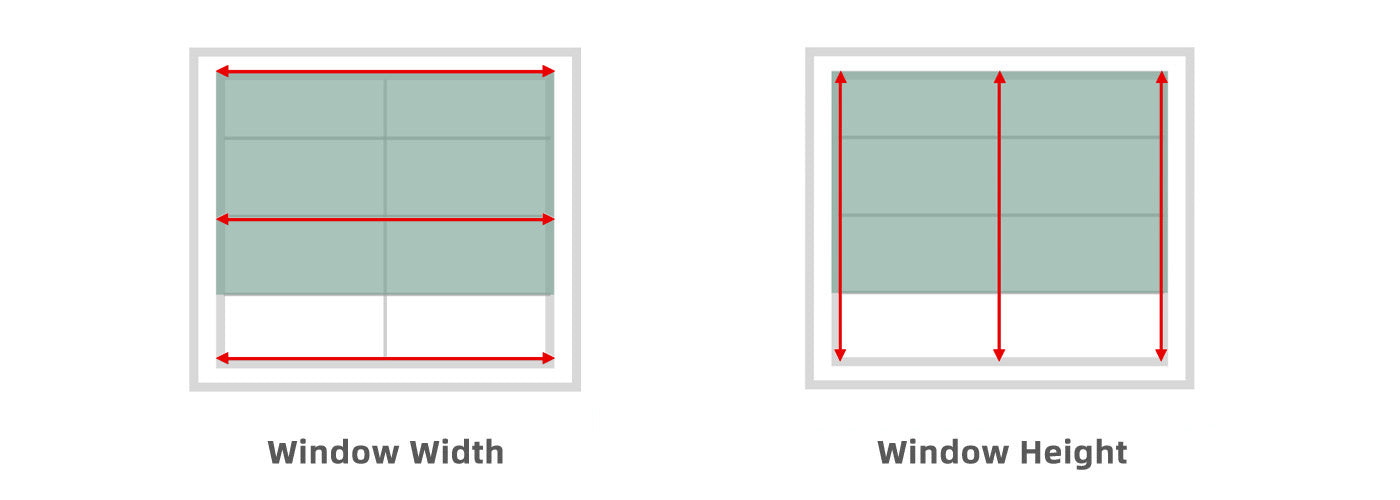
You have two mounting options. Inside mount places the shade within the window frame for a clean, built-in look. Outside mount secures it above or around the frame for maximum light-blocking coverage.
Feel painful to get it right? check our AOSKY's window measure tutorial article and video to get it done right and easy ways! Note that our tutorial suits all types of shads selling at AOSKY. Contact us if you still do not know how to measure it.
How to Measure Window Width and Height
Installation Video Tutorial
Measure Video Tutorial
1. Inside Mount — How to Measure
Inside mount means your shade sits inside the window frame. There are two styles: Top Mount (default) and Side Mount. When you place an order, Top Mount is selected automatically unless you change it.
Width
Measure the width across the top of the inside of your window frame. Round down to the nearest 1/8 inch.
Order this exact measurement — do not subtract anything. The factory will automatically deduct about 1/8 inch (3.2 mm) during production so the shade fits properly. Your order width will include the valance.
📐 Example: You measure 36 3/16″. Round down to 36 1/8″ and order that. The factory will trim it to about 36″ for a perfect fit.
⚠️ Splayed or recessed frames: If your window frame angles inward or has an uneven recess, measure the narrowest point and use that as your width. Otherwise, the shade may be too wide to fit.
Height
Measure the height at the center of the inside of your window frame. Round up to the nearest 1/8 inch. Be as precise as possible.
Then add 4 inches to that number — this is your order height. The extra length gives the shade a cleaner, more finished look when fully lowered.
📐 Example: You measure 48 5/16″ at the center. Round up to 48 3/8″, then add 4 inches. Your order height is 52 3/8″.
Order Height = Measured Height + 4″
2. Outside Mount — How to Measure
Outside mount means your shade sits on the wall or trim above the window frame, covering it from the outside. This is a great option when you want maximum light blocking or when your window frame is too shallow for an inside mount.
Width
Measure the full width of your window frame (or the area you want the shade to cover).
Then add 3 to 6 inches (1.5–3 inches per side) so the shade extends beyond the frame on both sides. This eliminates light gaps and gives better privacy. Your order width will include the valance.
📐 Example: Your window frame is 36″ wide. You want good light coverage, so you add 4 inches (2 inches per side). Your order width is 40″.
Order Width = Measured Width + 3″ to 6″
Height
Measure from where you want the top of the headrail to sit down to where you want the shade to end (typically a few inches below the window frame).
Then add 3 to 6 inches to ensure full coverage above and below the frame. Your order height will include the valance.
📐 Example: Your window frame is 48″ tall. You want the shade to start a little above the frame and hang a little below it, so you add 6 inches (3 inches above and 3 inches below). Your order height is 54″.
Order Height = Measured Height + 3″ to 6″
Step 2: Choose Your Material Strategically
Material selection goes beyond color preference. You're making two functional decisions at once: the level of light filtration and the visual texture.
The critical decision here is light-filtering versus blackout opaque bands. Light-filtering options allow a soft glow of natural light even when bands are aligned, which creates a warm ambiance but won't achieve darkness. Blackout bands create a room-darkening effect when overlaid, though as discussed above, they still won't match the total darkness of a dedicated blackout shade.
Always order swatches before committing. How a material looks on a screen is dramatically different from how it behaves with light passing through it in your specific room.
Step 3: Select Your Control Type
You have three control options: cord, cordless or motorization.
A continuous loop (cord type) is the simpler, more affordable choice — a looped chain that hangs from the headrail and is kept taut by a tension device. Where as a cordless control type is the most common one I would recomend for you, as here at AOSKY, this presents a clean look and safety for homes with children and pets.
Motorized zebra blinds let you control everything via remote, smartphone app, or voice assistant. Smart motorized blinds are compatible with Amazon Alexa, Google Home, HomeKit, and other smart home systems, enabling scheduling and automation — and modern motorized options can even be solar-powered, with multiple charging options including solar panel, USB, or power bank.
However, motorization isn't without trade-offs. This is because motorized zebra blinds may require more maintenance than manual blinds, with battery-powered versions needing periodic replacements that add to long-term cost. According to Blinds.com, expected battery life is approximately 6 months on a full charge, based on 2 up/down cycles each day.
The Child Safety Factor: What's Changed (and Why It Matters)
This is one of the most critical topics that the original article barely touches, and it has changed significantly in recent years.
The Window Covering Safety Council reports that a revised safety standard, ANSI/WCMA A100.1-2022, went into effect, eliminating the use of free-hanging operating cords, free-hanging tilt cords, and multiple cords into a cord connector on all made-to-order custom window covering products. If you have young children or pets, this should be a primary consideration.
The U.S. Consumer Product Safety Commission (CPSC) has recalled zebra blinds with long operating cords that can cause death or serious injury to children, due to strangulation and entanglement hazards. This isn't theoretical — it's an active regulatory enforcement area.
The practical takeaway: if your household includes children under 8, choose cordless or motorized zebra blinds. If you opt for a continuous loop control, make absolutely sure a tension device is properly installed to keep the cord taut against the wall.
When Zebra Blinds Are the Right Choice
Based on everything above, zebra blinds are genuinely excellent for specific applications.
Living rooms and home offices where you frequently adjust light throughout the day are prime candidates. We always believe that zebra blinds combine the functionality of a traditional blind and a sheer shade into one product, with alternating stripes that offer unmatched control — allowing you to switch between a clear view, filtered light, and full privacy with a simple adjustment.
When to Skip Zebra Blinds Entirely
No window treatment is universal, and zebra blinds have clear limitations. Skip them for very narrow, small, or odd-shaped windows where the banding pattern becomes visually compressed and loses its effect. Avoid them as your sole blackout solution for bedrooms where total darkness is needed — pair them with blackout curtains instead, or choose a different product.
And as mentioned, keep them out of bathrooms, basements, and other high-moisture environments where the dual-layer fabric is vulnerable to humidity damage.
Installation: DIY or Professional?
We provides a clear installation process that makes it sound straightforward: gather tools, measure, mark brackets, fasten brackets, mount headrail. For a standard inside-mount installation on a single window, most handy homeowners can manage it.
However, although zebra blinds are easy to use, installing them can be tricky, especially with larger windows or motorized options — you may need professional help to ensure proper installation and functionality.
My honest recommendation: if you're installing more than three windows, or if any of them are oversized or motorized, the cost of professional installation is worth avoiding the frustration of misaligned bands and uneven headrails.
Cleaning and Long-Term Maintenance
Maintenance is one of zebra blinds' genuine strengths, though they do require slightly more care than standard roller shades.
We recommed that zebra shades should be dusted regularly with a soft cloth or duster to remove surface dust, and for stains or deeper cleaning, a lightly dampened cloth with mild soap works well — but it's important to avoid harsh cleaning chemicals or soaking the material, as this can damage the fabric or cause the shades to lose their shape.
Conlusion
Zebra blinds are a genuinely impressive window treatment for the right application — they offer a level of light control versatility that no single-layer product can match, wrapped in a modern aesthetic that's proven to be more than just a passing trend. But they're not the right choice for every window in your home.
The smartest approach is to think room-by-room. Use zebra blinds where you'll actually benefit from their adjustable light control — the living room, the kitchen, the home office. For bedrooms that need total darkness, pair them with curtains or consider alternatives. For bathrooms, look at moisture-resistant roller shades instead. And whatever you choose, prioritize cordless or motorized options for any space accessible to young children.
Ready to start? Order swatches of your top material choices, measure carefully using the inside/outside mount guidelines above. If you want a guided experience, we offer in-person consultations with design experts who can help you finalize every detail.
Share